
🌍 Executive Summary — Singapore Business Carbon Report 2025

Singapore’s 2025 Business Carbon Report underscores a decisive shift: climate reporting is no longer optional, it is core to competitiveness.

📊 Key Highlights
Carbon as cost discipline: With Singapore’s carbon tax rising to S$45/tonne in 2026 (headed to S$50–80 by 2030), emissions are now a measurable financial liability.
Reporting momentum: Over 444 CERT submissions and nearly 2,000 professionals trained under the LowCarbonSG programme reflect growing adoption of carbon tracking.
Emissions profile: Participating companies reported 3.01 MtCO2e (Scope 1+2), with large enterprises driving 59% of emissions despite SMEs forming 80% of submissions.
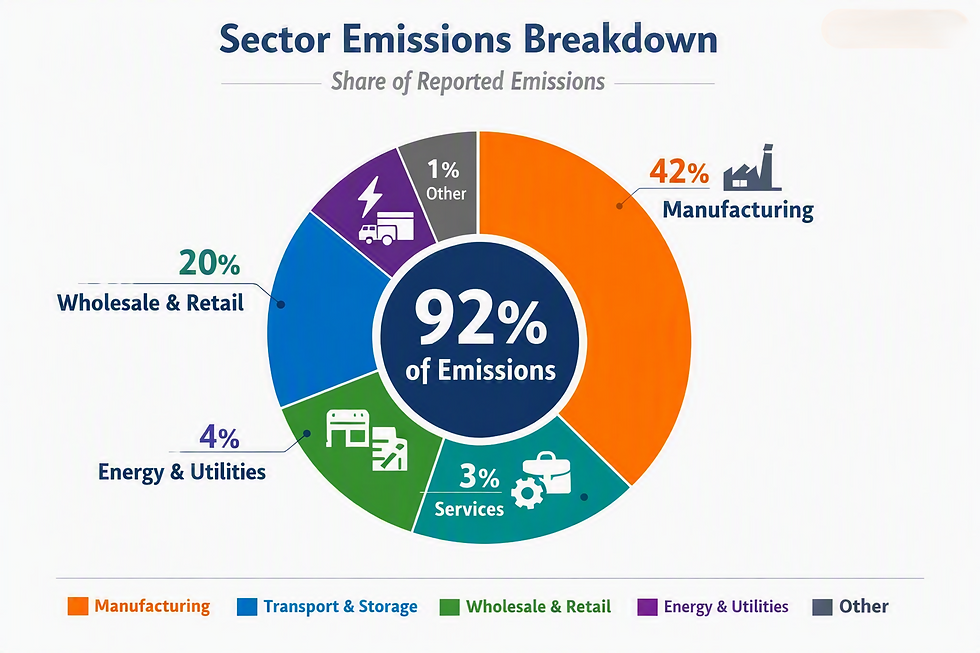
Sector concentration: Manufacturing, Transportation & Storage, and Wholesale/Retail account for 92% of reported emissions, highlighting priority areas for reduction.
Capability gaps: Data quality, systems, and skilled personnel remain the biggest hurdles, especially for SMEs.

🚀 Strategic Imperatives
Compliance as resilience: Aligning with ISSB standards and the revised SGX/ACRA roadmap ensures credibility and investor confidence.
Scope 3 readiness: With disclosure expectations tightening, businesses must build systems for supply‑chain emissions.
Sector‑sensitive benchmarking: Intensity‑based measures (per revenue, employee, or floor area) provide fairer comparisons than aggregate totals.
Recognition system: From 2026, LowCarbonSG’s 3‑Tier Recognition (Participant, Practitioner, Leader) will spotlight companies achieving year‑on‑year reductions.
🌱 The Big Picture
Singapore’s trajectory is clear: net zero by 2050, with interim targets of 45–50 MtCO2e by 2035. For businesses, climate reporting is not just compliance — it is a strategic lever for efficiency, resilience, and market access.
Airgorithm stands ready to support enterprises in turning reporting into stewardship, enabling credible data, actionable insights, and leadership in the low‑carbon economy.

For full Singapore Business Carbon Report 2026 : Tools & Resources – UN Global Compact


Comments